
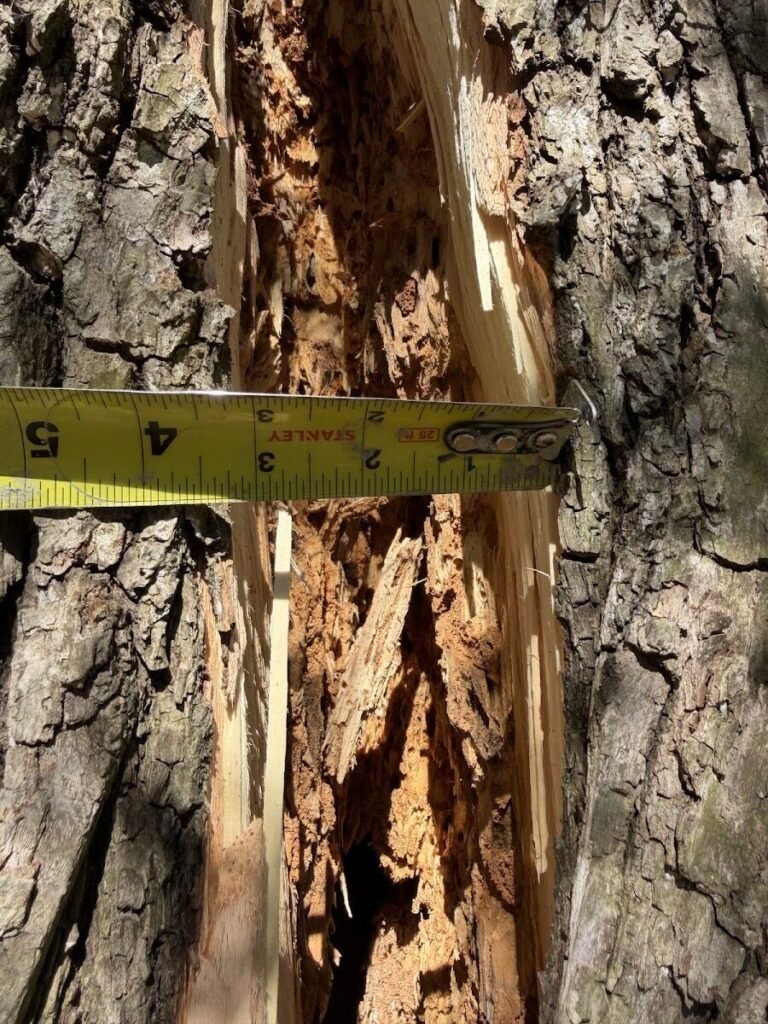
The Asian longhorned beetle is a tree-killing pest under active quarantine in Worcester County, MA. Look for perfectly round exit holes about the size of a pencil, shallow oval egg pits chewed into bark, sawdust collecting at the base or in branch unions, and dieback in maples and other hardwoods. I am an ALB compliance certified contractor. If you suspect ALB, do not move the wood, and call an arborist.
I’m Jon Pasquale, an arborist in Brookfield. The ALB story is personal for anyone who works on trees in this county: since the beetle was found in Worcester in 2008, tens of thousands of infested trees have been cut down to stop it. Here is what every homeowner in the Brookfields and surrounding towns should know.
What the beetle looks like
An adult Asian longhorned beetle is hard to mistake once you have seen one: about 1 to 1.5 inches long, glossy black with irregular white spots, and antennae longer than its body, banded in black and white. Adults are most active in late summer. August is actually national Tree Check Month for exactly that reason, so late summer walks around your yard are the best time to look.
The common local look-alike is the whitespotted pine sawyer, a native beetle that is duller, bronzy-black, and has a single white spot at the top of its wing covers where they meet. Finding one of those is not an emergency. Photograph anything you are unsure about and let someone confirm it.
The signs on the tree matter more than the beetle
You are more likely to see the damage than the insect itself. Check trunks and big branches for:
- Round exit holes, about 3/8 inch across, so perfectly round they look drilled. A pencil will slide into one.
- Egg pits: shallow, oval wounds the size of a dime chewed into the bark, often weeping sap.
- Frass: coarse sawdust collecting at the base of the tree or in branch crotches.
- Crown dieback: dead or thinning limbs in the upper canopy of an otherwise established hardwood.
Which trees are at risk
Maples are the beetle’s favorite, which is exactly why Central Massachusetts, a region full of sugar maples, red maples, and Norway maples, is where the fight is happening. It also attacks birch, willow, elm, horsechestnut and buckeye, and poplar. Oaks and pines are not its targets. If your property has mature maples, they are the trees to check.
Where the quarantine stands now
The regulated area today covers roughly 98 square miles in five communities: Worcester, Boylston, West Boylston, Shrewsbury, and Auburn. In July 2025 the Town of Holden became the first community removed from the quarantine, which is real progress. Inside the zone you cannot move firewood, woody debris, or other regulated wood out of the area without a compliance agreement or permit. That is the program I am certified under as an ALB compliance certified contractor.
The Brookfields are outside the quarantine zone. That is good news, and it is also the point: the way this beetle spreads to new towns is people moving firewood. Keeping it out of our towns is cheaper than what Worcester went through, which was the removal of over 35,000 trees.
What to do if you think you found it
- Do not move the wood. No firewood, no brush hauling, nothing leaves the property.
- Photograph it. The beetle if you can, and the holes or egg pits either way. Try to capture something for scale.
- Report it. The Massachusetts ALB eradication program and USDA take reports directly, and inside the quarantine zone the program removes confirmed infested trees at no cost to the homeowner.
- Have an arborist look at the tree. Most suspected ALB turns out to be something else, often emerald ash borer, native borers, or woodpecker work. Knowing which problem you actually have decides what happens next.
Authoritative resources: the state guide at Mass.gov, the Massachusetts ALB Eradication Program, and the USDA APHIS ALB program.
Questions homeowners ask about ALB
What does an Asian longhorned beetle look like?
Glossy black, 1 to 1.5 inches long, white spots, and banded black-and-white antennae longer than its body. The native pine sawyer looks similar but duller, with one white spot where the wing covers meet.
What trees does ALB attack?
Maples first, plus birch, willow, elm, horsechestnut and buckeye, and poplar. It does not go after oaks or pines.
What do I do if I find ALB?
Do not move any wood off the property. Photograph the beetle or the damage, report it to the Massachusetts ALB program or USDA, and have an arborist confirm what you are seeing.
Is Worcester County still quarantined?
Yes. As of 2026 the regulated area covers about 98 square miles across Worcester, Boylston, West Boylston, Shrewsbury, and Auburn. Holden was removed from the quarantine in July 2025, the first town to come out. The Brookfields are outside the zone.
Worried about a maple? Have me look at it.
I check for ALB, emerald ash borer, and the rest of the pests working through Central Massachusetts as part of plant health care and arborist consultations. Call me at (508) 769-5489 for a free on-site estimate in Brookfield and the surrounding towns.
About the author: Jon Pasquale is a practicing arborist in Brookfield, MA, working since 2006. Trained at the Stockbridge School of Agriculture at UMass Amherst, ISA member, Asian Longhorned Beetle compliance certified contractor, fully insured.